PS - If you want to hear one of the clips that I dug out from my archive and played in the session, here it is...
Friday, 23 March 2012
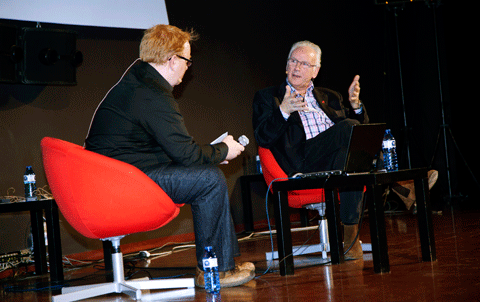
Radiodays Europe 2012; "How was it for you...?"
PS - If you want to hear one of the clips that I dug out from my archive and played in the session, here it is...
Wednesday, 20 August 2008
"A Local Show... for Local People"

Another week goes by and another 'networking' announcement for us in the radio business to absorb. This time it was the turn of Bauer's Scottish stations (that were formally the SRH group) to succumb to the temptation.
Radio Clyde will be the base for the weekday evening programming with Romeo (so good he's only known by the one name... think Madonna, Kylie etc.) doing a Scottish version of the 'In Demand' Show, and then Clyde's Gina McKie doing the late show. The weekend stuff is still to be announced, but I think we can expect more off-peak and overnight networking, perhaps with some specialist shows thrown in for good measure.
The justification for all of this is 'quality of product' and not cost-saving, according to Bauer and their delightfully enigmatic MD of the network, Travis Baxter. I buy that. They're not going to save a whole load of money by culling some badly paid late night jocks. The argument is that by wielding the 'power of the group' the quality of sessions / interviews etc improves, as those promoting their wears have a one stop shop to visit, rather than schlep around rainy Scotland... sorry, I mean travel in style around the most delightful shores of the British Isles.
Will listeners care that their 'local' DJ has been replaced in most cases by someone from out of town? Scotland is quite tribal in many ways, and radio is no exception. Many of the stations have built up loyal audiences, all be it quite young and sometimes quite small, in the evening. Is it a nostalgic and romanticised notion to want these evening shows to continue to exist, or has the radio world changed so much that local only makes sense in peak time?
Growing up in Liverpool in the 80's, my connection to pop culture was principally through the radio, and mostly every evening from 7pm till when I finally fell asleep. Tony Snell was the DJ on Radio City (he's still going strong on BBC Radio Merseyside now I'm glad to say) and through him I felt part of my home town, I knew what was going on... I knew the places he was talking about... I knew the schools he was mentioning... and I knew that somehow I was connected to all the other kids in my area via this strange and wonderful evening show that he presented and everyone listened to. (Tony also highlighted a whole load of bands to listeners and knew so much about music, but DJ's who know about music... that's another conversation!)
My point is this. Would I have felt less of a connection to my hometown (and loyalty to my local radio station) if the show was a generic networked show, produced... say... from Manchester. Actually, I probably would have done. Radio City gave me a little piece of my own tribal identity as a kid from Liverpool growing up in the 1980's. I felt there were others like me and a sense of localness was really important to me at age 13. After all, at that age, there's not much that defines you more than where you are from.
So, I fear, there will be a generation of kids growing up in the Scottish towns and cities who will no longer be served by their 'own' little evening / late shows, but by a rather generic product imported from another universe. Will they care? Possibly. Possibly not. But I know that having that connection to something very real and very local certainly gave me something to cling on to in those 'interesting' teenage years of development; a sense of identity and a reference point that was unique.
The debate about local v networked will no doubt continue, but the drip, drip effect of more and more networking seems to be irrevocably eroding the very fabric of what still makes radio different. It's localness.
Friday, 23 May 2008
'Networking' - A Trump Card?
As soon as UK media regulator Ofcom announced in February that it was relaxing the rules on the amount of local programming it required stations to broadcast, it was only a matter of time until the bigger radio groups took advantage of this. ‘Global Radio’ were the first out of the traps with the move to network all output across Heart, aside from breakfast, mid-morning and Drivetime. ‘Galaxy’ have kept local Breakfast and Drivetime shows, but networked everything else.Next was GCap (soon to be Global, so they’re pre-empting the inevitable really) who announced a new 3 hour daytime show across the One Network, details of which are still a little sketchy to be honest! And recently the three Xfm stations in London, Manchester and central Scotland announced they’re going to network another three hours of programming on weekdays, taking the local output from 10 hours to 7 hours. Lots of smaller UK radio groups are also taking advantage of the rule change and going a step further to relocate stations in central ‘broadcasting hubs’, with the obvious economies of scale that this brings.
So far Bauer have resisted the temptation to go for any daytime networking, with their ‘In Demand’ evening show being the only real networked programme. So what’s the deal? Is this good for listeners… good for the radio station… good for advertisers? Who benefits?
Yesterday, at the Radio 3.0 Conference in London, outgoing GCap Chairman Richard Eyre had some thoughtful insights about networking.
"Piping in a mega-DJ from London would mean sacrificing the key element of local radio: localness. The economics of radio in 2008 will mean that companies will not be able to resist. But it's still handing over one of our best assets to reduce costs. The economics say delocalise. But the relationship says keep it local."
With comments like that, it seems a shame that he’s the outgoing chairman really. I can’t help thinking that despite the best efforts of some radio executives to convince me otherwise, it’s all about saving money in the short-term during an economic downturn, and not thinking about the long-term effect of stripping localness from radio. I’m sure Global Radio have in their top drawer a plan to turn lots of their newly acquired GCap stations into the ‘Heart’ brand. How long before we hear a station’s positioning change to … “Fox FM – The Heart of Oxfordshire”. And we all know what comes next.
It’s quite easy to be snobby about the quality of some stations when you have a portfolio that includes well resourced brands like Heart and Capital on your books. And yes, the quality of the smaller stations could be improved in many places. But is the answer just to network this ‘mega-DJ’ from outside the area. Surely investing in training and development of new talent and programming skills on a local level is a more important long term objective? Go to places like Liverpool, Manchester, and Leeds and imagine a world where Radio City, Key 103 and Radio Aire were pseudo-national stations with perhaps a local breakfast show as the only indicator of their true parentage. Sure you can use smoke and mirrors all you like to give the impression the output is ‘local’… but for me, you can’t beat the real thing. It doesn’t matter how good your smoke screen is, because local radio is best when it’s local… and not pretending to be local.
The next 12 months will see the inevitable ‘character-stripping’ out of many truly local stations, with some of their output replaced with no doubt well-produced, slick, but rather soulless programming. The radio landscape will be painted magnolia… designed to cause least offence, but not engender a reaction of any kind. Is this the type of local radio listeners want?
One of the great clichés about succeeding at programming a local / regional station is “Play the local card”. It seems that the deck is about to be rigged.
Friday, 23 March 2007
Have Radio... Will Travel
There were some really good things I heard…. And some not so good things too!
Let’s start with one really good thing - Radio City’s “sense of place”.

Here’s a station that loves Liverpool and loves the North West. You can hear it pouring out of the speakers every time you turn on.
Liverpool will be the European Capital of Culture in 2008, and Radio City are a main media partner for this. And they own it big time on air. Promos, liners, news elements, adverts. It’s all there. It gives the station a real connection with the city and you feel like this is a station really made with its listeners in mind.
Their news is first rate and the local pride is tangible. They manage to sound like a contemporary radio station, but with all those “old fashioned” elements of traditional ILR presented in a modern and dynamic way.
If you want an example of how to do “local” really well – tune in to Radio City for the day. It reminded me again of the importance of localness and when done well, how it can still sound really good, whatever the format. Big thumbs up guys!
Newton’s Third Law applies to radio too. “For every action, there’s an equal and opposite reaction”. So there were a few dodgy things I heard on the dial as well.
In no particular order…
There are still too many clichéd DJ’s. They don’t talk to us, the listeners.… they bark, shout, and sing-song, and over project their way through shows. They start sentences with phrases like “All this week, we’ve teamed up with…”. They make you want to rip the radio out of the dashboard and then head butt the steering wheel repeatedly. Please stop!!
Listening to them this week, it’s shown me how there’s a huge opportunity for decent, honest, well-spoken communicators to shine through.
Century 105.4 have an OB from Caribbean hosted by Darren Parks currently on mid-mornings. It really blurred the line between programming and advertising for me. It was just one long ad for the resort he was staying in. It was really a case of massively over delivering for the client, and not really being focused on the listeners back home.
Darren’s a great presenter but there was a bit of a “I’m here having so much fun here on the beach… while you’re all freezing your arses off back home and queuing on the M6 at the Thelwall Viaduct. Ha Ha!” feel to the show.
Here’s the question. Foreign OB’s – Can they be interesting and relevant to listeners or are they just a money making exercise for the station?
Finally, Back to Radio City. Kev Seed, the breakfast show host does, this thing called a “Seedy Hug”. It was the strangest thing I’ve heard on the radio for quite some time!
Imagine a radio DJ equivalent of Baz Lurman’s “Everybody’s Free to Wear Sunscreen”… delivered live! That’s the nearest I can get to describing this... this "thing".
It’s kind of like a feature that designed to make you feel good on a Monday morning. There are stories will morals and happy endings. Rules for how to live your life, how to be good to others etc. It has a pseudo religious feel about it, and the one I heard this week felt like Kev was delivering a sermon from the pulpit of “The Church of Seed”. Just odd.
Just to give you a flavour, it ended with the lines…
“Remember, each of us is a vital thread in another person’s tapestry. Our lives are woven together for a reason. One of the best things to hold on to is a friend”
… and then it went into some mawkish song. All this at 8:20 on a Monday Morning!!
It was so bizarre!!
Kev’s been doing the show for ages and is very successful in Liverpool. He has a really good rapport with his listeners and is obviously still popular, but I just didn’t get this at all.
Judge for yourself by all means, (there are text versions here for you to read on the Radio City website) but it was the strangest bit of radio I’ve heard in a long while!


